Thursday, April 08, 2021

Soufriere volcano updates

 Updates on the volcano

7th May 2021 21.00 PM local

There is no change in the state of the volcano. I hope the downgrade of the alert to orange is just in time to prevent a massive Covid-19 outbreak. From now on, I will keep updating the Covid dashboard, but not this volcano topic.

6th May 2021 11.00 AM local

As I mentioned yesterday, the alert level has been changed to orange. Here is the full press release, and below that the infographic with what this entails.

The UWI St. Augustine, Trinidad & Tobago. Thursday, May 6, 2021. 
— The Government of Saint Vincent and the Grenadines has lowered the volcanic alert level at La Soufrière to ORANGE based on a recommendation from The University of the West Indies Seismic Research Centre (UWI-SRC).    

UWI-SRC/MVO Volcano-seismologist and current Scientific Team Lead Roderick Stewart made the recommendation to the cabinet on Tuesday, May 4, during his update on the recent activity at the volcano.  Mr. Stewart indicated that the recommendation was being made given that there have been no explosions at the volcano since April 22, and the number of volcanic earthquakes recorded has also decreased significantly. At alert level ORANGE the volcano may resume explosions with less than twenty-four hours of notice.

Lahars (mudflows) continue to pose a dangerous threat to the river valleys surrounding the volcano, including Wallibou and Rabacca. Mudflows observed over the past several days have contained boulders up to 5m (15 feet) in diameter. Scientists also observed steaming flows, which are likely due to contact with and incorporation of hot volcanic deposits. Lahars can cause damage to property and severe injury to persons in their path.  Access to the RED volcanic hazard zone should be limited to government-approved essential work only. Conditions remain hazardous, and the potential for injury also remains.


5th May 2021 21.00 PM local

And the update tonight is that the seismic team will give updates Mondays, Wednesdays, and Fridays from now on.

5th May 2021 10.00 AM local

Possibly back to orange alert very soon!

The volcano is still keeping quiet, and with the rainy or hurricane season starting soon, the danger of lahars will only increase for months, maybe even years to come.
Today in the cabinet meeting there will be a discussion, and there may soon be a decision to lower the alert level to orange.
This would mean that persons evacuated from the orange zone can move back to their homes, and the government can start cleaning up in the red zone.
With the threat of lahars, it will also be time to rethink locations and building requirements in the red zone.
This is good news and maybe just in time to prevent an outbreak of Covid-19 in the shelters.

3rd May 2021 21.00 PM local

The seismic pattern is still the same. This morning Dr. Stewart, the seismologist monitoring the volcano, said that it should be reasonably safe to return to the orange zone as long as the government knows of the return so they could quickly assist with evacuation if necessary.
Multiple lahars were recorded again.
SO2 flux was measured and came at 1036 tons per day; I have no idea if that is a lot or not.

1st May 2021 21.00 PM local

The seismic pattern is still the same, with only a few long period, volcano-tectonic and hybrid earthquakes. A few small lahars were recorded. And another beautiful time-lapse video from today, the volcano is still venting.

30th April 2021 21.00 PM local

The seismic pattern is still the same, with only a few long period, volcano-tectonic and hybrid earthquakes. A few small lahars were recorded. 
The question I asked last Wednesday has been answered by UWI seismic; here it is:
Question: How does the current seismic activity at la Soufriere compare with that of other active volcanos that are not erupting, like Mt Pelee, for example? When can you say an eruption has ended, does the seismic activity need to go to non-existent, or can there still be a low level of activity?
Answer: Current seismic activity is comparable to volcanoes that aren’t erupting. To say an eruption has ended we would need low seismic activity but not necessarily zero. The decision on it being over is not based solely on seismic activity. Also depends on ground deformation and gas.
And here is a beautiful timelapse video of today, taken from the Belmont observatory, credit Richard Robertson, UWI-SRC


29th April 2021 21.00 PM local

No change in the seismic pattern. It is still raining, the lahars continue on the flanks of La Soufriere> Some of the lahars are steaming, having passed through hot volcanic deposits. Many of them carry trees, which are now forming a hazard at sea.
 
29th April 2021 15.30 PM local

It has been raining heavily for part of the night and all day so far, causing multiple lahars, flooding, and mudslides. Several houses have collapsed.

28th April 2021 21.30 PM local

Still quiet,  only a few long period, volcano-tectonic and hybrid earthquakes have been recorded. Something is causing these though, the question is, does this always occur at active volcanoes even when there is no eruption taking place?

28th April 2021 11.45 AM local

Still quiet inside the volcano. The main danger at the moment is the lahars.

27th April 2021 20.45 PM local

No change in the seismic pattern. Some lahars have been recorded this morning after rain. A lahar is a rapidly moving flow of ash, volcanic deposits, mud, and anything it meets. When these lahars met hot volcanic deposits, clouds of steam were seen. Being anywhere near these mudflows is not safe. This is one of the reasons the alert level is still red.

27th April 2021 11.35 AM local

No change; the volcano is keeping quiet. One issue at the moment is that a comparison with the situation before the effusive eruption started is not possible. The seismic measurement station near the top of the volcano has been destroyed by the explosive eruption. The other stations have been placed after the effusive eruption started.
This morning's advice was that cleanup could start in the orange zones and as far north as Georgetown, but the alert level remains red.

26th April 2021 21.15 PM local

No change in the seismic pattern. The seismic team flew in a plane near the volcano today; it was too cloudy to see everything inside the crater. Near continuous steam venting was observed out of several places in the crater. Here is a picture they took:


25th April 2021 21.00 PM local

No changes in the seismic pattern. The team monitoring the volcano published a radar/satellite image of the crater as it looks now; this is their comment: "satellite radar imagery acquired on 24th April indicates probable continued growth or formation of a lava dome following the explosions on 18 and 22 April". And here is the picture:


25th April 2021 12.15 PM local

No changes in the seismic pattern so far. The scientific team has made a presentation explaining the various types of earthquakes that occur at La Soufrière. I have copied this here.

24th April 2021 21.15 PM local

The volcano is keeping quiet, with only a few long-period, volcano-tectonic and hybrid earthquakes.

23d April 2021 21.15 PM local

The update today says there were a few long-period, volcano-tectonic and hybrid earthquakes. Nothing to report really. Last night a few lahars were recorded around 9 PM, location unknown.

23d April 2021 16.15 PM local

No update was provided as yet today. Professor Robertson did indicate this morning that there seems to be an interval of a few days between eruptions, so as soon as there is any update, I will publish it.

22nd April 2021 20.15 PM local

The eruption this morning at 11.09 AM generated a high-level seismic tremor which continued for 20 minutes. After that low-level seismic tremor occurred, which lasted for about 2 hours while the volcano continued ash venting. The first ash plume rose about 8km high. There was also a PDC (pyroclastic flow) moving down the western flank of the volcano. Time-lapse of the explosion below:


22nd April 2021 11.30 AM local

Right now there is an explosive event. The ash cloud does not look as spectacular from my porch, I was even wondering if it was an eruption or a cloud.
Before the eruption, the long period earthquakes have been increasing. I will update the exact time of the eruption; in Bequia Admiralty Bay we see it a bit later than the actual occurrence.
This is a picture taken from the observatory by the scientists at 11.08AM:


21st April 2021 21.00 PM local

Hardly any change, except that the long period earthquakes are increasing in rate and some rockfalls and volcano-tectonic earthquakes have been recorded. Below is a photo of the seismic plot. Sorry for the alignment and the ad; I try to make the picture as large as possible.


21st April 2021 12.30 PM local

No change; there might be a dome building: the long period earthquakes are associated with the movement of magma. If there is not enough gas in the magma, a dome will build. This dome then functions as a cork, and if there still is gas present in the magma, pressure will build up, and the cork will pop, which we will see as an explosive eruption.
The gas measurements done so far do not give sufficient information yet to calculate anything about timing. According to the scientists, the expectation is that at least one or two eruptions could still occur.

20th April 2021 21.30 PM local

No change in the seismic pattern. In addition to the long period earthquakes some rockfalls were recorded and some volcano-tectonic earthquakes.

20th April 2021 11.30 AM local

No change in the seismic pattern during the night. One of the seismic stations recorded the signal typical of a mudflow (lahar) that may have come down on the south-eastern side of the volcano.

19th April 2021 19.00 PM local

The volcano is still at the long-period and hybrid earthquakes. The periods between eruptions seem to be getting longer, so I hope we will have nothing to report for the next 36 hours at least!

19th April 2021 11.00 AM local

Seismic tremor continued until 21.00 PM yesterday. After that, the long-period earthquakes started back until 1 AM, after which their rate dropped.
The GPS positions keep changing, probably corresponding to inflation and deflation of the mountain.

18th April 2021 21.00 PM local

At 16.49, an explosive eruption occurred. The ash plume went up about 8km and drifted to the west southwest. It generated some interesting cloud formations and sunset!
The same long period earthquakes are continuing, the explosion generated a  seismic tremor.
The scientific team says this kind of activity is an indication of build-up and subsequent destruction of a lava dome.

18th April 2021 16.00 PM local

Near continuous long period and occasional volcano-tectonic earthquakes are still reported by the scientific team. The long period earthquakes usually are associated with the movement of magma and could mean that a lava dome is building.

17th April 2021 16.00 PM local

For the time being, the long period earthquakes have continued at a low level, and there were no tremors. So it is nice to have nothing to report about the volcano!

16th April 2021 21.00 AM local

The seismic pattern continues with nearly constant long-period earthquakes and low-level tremors. At. At 6.15 AM, there was a high-level tremor associated with an explosive eruption and ash venting. 
More gas measurements were done and this time measured 460 tons a day.
Two GPS stations are still standing, one in Belmont and one in Georgetown. They are moving slightly in a Northeasterly and Northwesterly direction respectively, towards La Soufrière, indicating that the mountain is "shrinking" or deflating, caused by depletion of the magma chamber, at least let's hope so.

16th April 2021 11.00 AM local


Another explosive eruption occurred this morning at 6.15 AM. The eruption column was quite energetic and was about km high. The ash cloud went to the west of St. Vincent this time. The period between explosions now is about 40 hours, but we are not nearing the end yet...
Yesterday the scientists measured and calculated the amount of SO2 gas vented by the volcano and came to an amount of 809 tons a day. 
I wonder if this will have an effect on the next hurricane season, which is starting soon. If the SO2 gas reaches high enough, it will be in the form of aerosols reflecting sunlight and thus generating a cooling effect on earth. In this case, the cooling effect would be on the Atlantic Ocean. The seawater temperature plays a significant role in the formation of tropical storms and hurricanes. If it is too cold, there will be no hurricane.
.
15th April 2021 21.00 PM local

The seismic pattern has changed, there is now a nearly continuous long period earthquake, and there were three brief periods of low-level tremor. No explosive eruptions occurred, but there is still some venting. A new dome may be building. Could this eruption of La Soufrière 2021 be nearing its end?

15th April 2021 11.00 AM local

The same seismic pattern continued into the night, with bands of tremor separated by long-period earthquakes. From what I understand, these long-period earthquakes are associated with magma moving inside the volcano but with not enough energy to cause an eruption. Banded tremors started at around 2.30AM, and venting was observed around 4 AM. This venting did not go very high and consisted of ash and gases that went up about 4000 feet. Most of it blew westward, offshore. On satellite imagery, it looks like there was some more venting at about 10 AM this morning.
The periods between eruptions are getting a bit longer now, about 14 hours, while venting continues.
A lot of aid is arriving for displaced persons, the distribution is posing some logistical challenges, especially for those housed in private homes.

14th April 2021 21.00 PM local

The same pattern of tremor and earthquakes continued today. The last two eruptions were about 13 hours apart. They seem less energetic and contain a lot of gas. Below is an animation of the entire explosive eruption stage of the volcano so far which perfectly depicts the tremors and the periods between eruptions.


14th April 2021 12.00 AM local

There has just been another explosion seen from my porch in Bequia. Update to follow.


14th April 2021 11.00 AM local

The same pattern of seismic tremor and  Long Period earthquakes (LP) increasing in strength continued yesterday evening, until an explosion at 22.48 PM. This explosion caused a pyroclastic flow (PDC) towards the east. Lahar's were also reported in Sandy Bay.
Professor Robertson said that the columns of gas and debris now have less energy causing them to collapse and generating these PDC's.

13th April 2021 21.00 PM local

This morning's eruption was a Vulcanian explosion, which is an explosion consisting of small to moderate explosive eruptions lasting seconds to minutes. PDC's can be generated, and ash columns can reach heights of 20 km. A large seismic tremor was registered during this explosion. After that, a smaller seismic tremor continued for 3 hours.
Before the explosion, there was an increasing number of Long Period earthquakes, and after the 3-hour seismic tremor, LP earthquakes are again increasing. These are smaller till now.
PDC's were again observed on the west coast.
There were several cruise ships in Kingstown to take persons displaced by the eruption to islands near St. Vincent. The majority of evacuated persons prefer to stay and go home as soon as possible. The ships have left.

13th April 2021 16.30 PM local

Two spectacular pictures of the eruption this morning, one from the South of St. Vincent and one from St. Lucia with the Pitons in the foreground. As you see, the air is clear, no ash, and the visibility is excellent except in the North of St. Vincent.


Update 13th April 2021 11.00 AM local.

The pattern of short bands of seismic tremors interspersed with long-period earthquakes continued into last night. Associated with these tremors and earthquakes was audible venting.
After 01.30 AM, the earthquakes became more frequent, and there was an explosion at 6.30 AM. According to professor Robertson, the lead scientist, this was more like a classic volcanian explosion with less ash and mainly gases. I am waiting for an official report, but on the radio, he said that there may be capping of the crater happening, and when there is enough pressure built up, it explodes.
This is a fast timelapse video of the eruption this morning:


Update 12th April 2021 21.00 PM local

After 6 am this morning, 3 tremors have been recorded, associated with explosive eruptions or increased ash venting. The episodes of tremors were 2-8 hours apart. Pyroclastics flows have been observed on the Southern and Western flanks of the volcano. They reached the sea at three locations. Extensive damage to vegetation has been observed. The East experienced heavy ashfall, no PDC's. Though Rabacca river is still steaming, it seems some lahars are making their way down on that side. These can be dangerous and destructive as well.
A picture is of a village on the Western coast of St. Vincent.


Update 12th April 2021 11.00 AM local.

At 4.15AM, there was a large explosive eruption of the volcano. Tremors were recorded with larger intervals between them than before, 5-8 hours, associated with ash venting.
Satellite imagery indicates that both the old and the new dome are gone. The eruptions now come straight out of the crater, which has an estimated depth of 800 meters. At this latest eruption, much larger and hotter fragments were ejected in the form of a column of gases and material that collapsed on the volcano's flanks.
This is the most dangerous part of the volcanic eruption. The collapsed column has become a pyroclastic flow or density current, also called a PDC. This flow of debris and ash is very hot (200-700 C or more) and moves with great speed and force, destroying and burning everything in its path.
A last rescue attempt will be made for anyone still in the Red Zone today.


Update 11th April 2021 21.00 PM local

Seismic tremors have been recorded throughout the day, coinciding with episodes of venting or explosive activity. Steaming in the upper parts of the Rabacca valley was observed at about midday. The cause of this phenomenon is was investigated, and the last I heard about it was that the scientific team thinks it was a lahar, hot material mixed with rain flowing down the river valley.
In Bequia, the ashfall is less than yesterday; it rained again at about 17.00 local time, which seems to clear the air.


Update 11th April 2021 11.45 AM local.


It rained last night in Bequia, and the air is much cleaner now. Ashfall is reported in Barbados, Saint Lucia, Grenada, and the Southern Grenadines.

b
Mainland St. Vincent had an island-wide electricity outage, some roofs in Sandy Bay have collapsed, and tree branches fall off under the weight of the ash.
Tremors have been recorded throughout the night every 1.5 to 3 hours, combined with eruptions or ash venting. I include a short video of the satellite imagery of last night.


Update 10th April 2021 20.45 PM local

We can't see anything to the North from Bequia, so I have been waiting for an update from the scientists in St. Vincent. Activity at the volcano declined somewhat last night, but this afternoon at about 15.30pm, banded tremors were observed, indicating that magma and gas were approaching the surface.
Each tremor episode lasted 20 to 30 minutes, with gaps between them of one to three hours, and at each episode, explosive eruptions or ash venting occurred.

I have been seeing these ash ventings on satellite imagery; I insert a zoomed-in image here. It was taken at 20.30PM local—a big blob of ash moving East.
This is the link to the satellite imagery, click on St. Vincent, and you will get the updated zoomed-in image.


Update 10th April 2021 15.00 PM local

Kingstown earlier today


Update 10th April 2021 11 AM local
Everything is covered in fine ash in Bequia. The lead scientist said this morning in a live update that the entire new dome of 13 million cubic meters may have blown off in the air yesterday. 
Update 9th April 2021 20.30PM local
A third eruption occurred; the volcano is very active with continuous tremors and venting. In the dark, lightning is observed in the ash plume.


    3rd eruption

Update 9th April 2021 16.15PM local
I am not sure if this is a third explosive eruption or still part of the second one. I just took this picture from the Belmont walkway in Bequia.


Update 9th April 2021 15.45PM local
A second eruption occurred at 14.45 and is either ongoing, or there may have been a third one just now.


    Second eruption


Update 9th April 2021 11.00AM local 
A short video of ashfall in Chateaubelair and one of the eruption itself, both shared on Facebook.


Update 9th April 2021 9.00AM local At 08.41 am, the expected explosive eruption of La Soufriere volcano began. The ash plumes reached a height of up to 8km. Ashfall has been observed as far South as the airport.
On infrared satellite images, the ash is observed traveling in a  Northeasterly direction.


Update 8th April 2021 21.00PM local An evacuation order has been issued for the North of St. Vincent. Picture from the monitoring equipment camera. Unfortunately, there is not enough bandwidth available for a live stream.

Update 8th April 2021 11.00 local: The volcano is emitting more gases and steam for the past few hours. Some images shared on Facebook:


From 3 am "banded tremors" have been recorded at one of the monitoring stations around the volcano. The lead scientist in charge of monitoring the volcano explained that a banded tremor is basically a continuous vibration of the ground and is often associated with magma moving towards the surface.


Update 5th April 2021: A new swarm of Volcano-Tectonic (VT) earthquakes began at the
La Soufrière Volcano at 6:38 am today. They occurred at a depth of about 6km. The largest so far had a magnitude of 3.9 and was felt by residents living in the volcano's vicinity.

Sunday, April 04, 2021

Covid dashboard for St. Vincent and the Grenadines

 Covid Dashboard

I find the official dashboard of the Ministry of Health somewhat chaotic, so I decided to make my own. Below is the draft; please comment if you have suggestions.
I personally would like to know the test backlog and/or the number of results pending, but that information is not provided. I wonder if there were no other Covid related deaths than the persons who died in hospital so far.

La Soufrière volcano St. Vincent

Soufrière in state of effusive eruption

The volcano in the north of St. Vincent has entered a state of effusive eruption since the 27th of December 2020. This was first noticed through satellite imagery used for tracking high temperatures (fires). In this case, the high temperature was caused by magma reaching the surface.
An effusive eruption means that magma (molten rock) reaches the surface producing a lava flow or dome. This generally occurs when there is a relatively low amount of gas. In an explosive eruption, pressurized gases are trapped within the magma, causing it to break apart violently.

The alert level is orange at the moment; no evacuation orders have been issued.

An extensive array of monitoring equipment has been put in place around the volcano, which should be sufficient for the scientists staffing it to notify the disaster management authorities on time.
Signals could include changes in gas chemistry, changes in the mountain shape, or volcanic earthquakes.

The new dome is hot: in the beginning, a red glow was observed. This turned out to be burning vegetation. Some of the smoke you see in the pictures is steam boiling the groundwater in the crater. From the 1st of February, sulfur dioxide gas was detected in the eruption. The scientific team thinks this is because the groundwater in which the SO2 was previously dissolving is now drying up.

The old dome is 130 meters high, the new one on 21st March is 105 meters high. Before the last explosive eruption of 1979, there was also a dome growth associated with an effusive eruption which started in 1971.

Starting at approximately 10:30 local time (14:30 UTC) on the 23rd of March 2021, the monitoring network recorded a swarm of small low-frequency seismic events, which lasted for about 45 minutes.  These events were different from previous activity in that they were also recorded on other stations.  
Starting at 16:53 local time (20:53 UTC) on 23 March 2021, the monitoring network started recording volcano-tectonic (VT) earthquakes. These earthquakes are normally associated with underground fractures of the rock mass and are commonly generated by magma pushing through an unyielding rock mass.  The volcano-tectonic earthquakes were located beneath the volcano, at depths down to 10 km below the summit.  The largest of these had a magnitude of 2.6.  Some of them have been reported felt by people living in communities close to the volcano, such as Fancy Owia and Sandy Bay.   It stopped again on the 26th.
The lead scientist monitoring the volcano, professor Robertson, says these volcano-tectonic earthquakes are associated with magma trying to push its way through, whereas the small tremors observed daily around the crater are associated with the growth of the dome.
Update 5th April 2021: A new swarm of Volcano-Tectonic (VT) earthquakes began at the
La Soufrière Volcano at 6:38 am today. They occurred at a depth of about 6km. The largest so far had a magnitude of 3.9 and was felt by residents living in the volcano's vicinity.

I include pictures, most taken by the monitoring scientists except the first one, of the development of the new dome. Please click to enlarge.


Picture posted on Facebook

    27th December


December
p
   January 6th dead vegetation


January

     1st February


12th February


  3rd of March


24th March
 b
     1st of April

Monday, January 18, 2021

Current Covid 19 situation in St. Vincent and the Grenadines

 Update on the Covid 19 situation in St. Vincent and the Grenadines

The Covid 19 situation in St. Vincent and the Grenadines has evolved from occasional imported 
cases for most of 2020 to local community spread in January 2021. This has possibly happened 
through various means, such as visits to people in quarantine, people not following the 
quarantine rules, contact with infected persons upon entry in the country or staff in "bubble" 
quarantine accommodation coming in contact with infected persons.
As of January 18th 2021, there are 375 active cases, most of which are local. These cases are 
discovered through contact tracing and persons with flu-like symptoms coming to health centers 
for tests.
There are 2 Covid 19 related deaths; both persons had comorbidities.
The Ministry of Health has just disclosed the locations where cases have occurred without providing numbers except that the clinic in Pembroke has the most positive tests. This clinic covers the South-Western part of St. Vincent. However, cases are occurring throughout St. Vincent and the Grenadines.

Thursday, July 23, 2020

Gonzalo St, Vincent and the Grenadines

Tropical storm Gonzalo is approaching the island chain

Question is: where will it pass through the island chain? The model I have found to be most reliable has it passing very near to Bequia.
However, at the moment the only input for this model seems to be satellite imagery and surface analysis, none of the Atlantic buoys have transmitted any data recently. This might be lack of maintenance due to the corona virus lockdowns.
Gonzalo is a very small system,which makes it hard to predict the future track. The stronger it gets, the more Northerly the track can be.

This is the official press release:

The government of Barbados has issued a Hurricane Watch for St. Vincent and the Grenadines.

At 800 AM AST (1200 UTC), the center of Tropical Storm Gonzalo was located near latitude 9.8 North, longitude 47.9 West. Gonzalo is moving toward the west near 12 mph (19 km/h).

A general westward motion at a faster forward speed is expected today followed by a turn toward the west-northwest on Saturday.

On the forecast track, the center of Gonzalo would approach the Windward Islands late Friday and Saturday. Maximum sustained are near 65 mph (100 km/h) with higher gusts.

Strengthening is forecast during the next couple of days, and Gonzalo could become a hurricane later today. Tropical-storm-force winds extend outward up to 35 miles (55 km) from the center. The estimated minimum central pressure is 997 mb (29.44 inches).


Covid-19 second wave in St. Vincent and the Grenadines

Importing new cases

Right after American Airlines resumed flights to St. Vincent and the Grenadines, as well as airports in other islands reopening their borders, there have bee new imported cases of Covid 19.
It was preferred that passengers had themselves tested and only flew if they tested negative, but not everybody adhered to that recommendation. Hence there were a total of 21 positive cases determined after testing in St. Vincent. 6 of these have now recovered, must be the climate, bringing the total active cases to 15.
It is now mandatory for persons wishing to travel from the USA to St. Vincent that they are tested negative for Covid 19 72 hours or less prior to their flight.

Sunday, May 03, 2020

Current Covid 19 status in St. Vincent and the Grenadines

Covid 19 in St. Vincent and the Grenadines: stage 2


Update 3rd May: A 17th person has tested positive, and one person confirmed recovered, bringing the total number of active cases to 8. Number 17 is part of the same cluster.
Update 29th April: A 16th person has tested positive, this one too is closely associated with the last cluster. Contact tracing has been done I suppose, the number of persons in quarantine has increased to 100.

Very quiet front street Port Elizabeth
Update 26th April
A 15th person has been tested positive, this one too is closely associated with case 13 and 14 who got it from an imported case.
 3 more persons have recovered as confirmed by 2 negative tests, bringing the total number of active cases to 7.
Update 23rd April
A 14th case has been confirmed, this one "closely associated" with case 13. At least 5 other persons are  closely associated with this last case, extensive contact tracing is being done to determine if there is now community spreading of the virus.
Several tests have been done for medical clearance of patients, two more are recovered. The  total recovered is now 5, active cases 9.
Update April 21st
This last person that tested positive has no recent travel history. The ministry of health now calls this a local transmission, meaning the person has been in direct contact with a patient with a travel history. As per the CDC: This is the stage of local transmission - when people who have brought the virus into the country transmit it to people they come in contact with, usually friends and family. At this stage, it is easy to trace spread and quarantine people.
This is different from community spread, where none of the infected patients have been in contact with an infected person that has a travel history. That would be stage 3.
April 21st
Today one more person has tested positive for the novel corona virus bringing the total of cases to 13. 2 of the active cases have been tested twice, result negative, and hence received medical clearance.
This brings the total active cases to 10.
It is unclear if this new positive is caused by local transmission or concerns a person who has travelled.

Saturday, April 18, 2020

The Corona virus in Bequia

The Corona virus in Bequia

18th April LIAT will continue to suspend all passenger services till the 15th of May.
 At the moment there are still 12 cases, of which 1 has recovered. Of the other 11 6 are now being tested to see if they recovered.
 Bequia Express will resume the regular schedule starting this Monday.
17th April Some of the persons infected with the virus are being tested now to see if they have recovered. A lot of people have completed their quarantine, so far there are no new cases and the total is still 12, of which 1 recovered.
10th April Of the 30 samples sent off, 4 tested positive.  They have now been placed in isolation. Quarantine had been extended by a week for 32 persons, they were supposed to have ended their quarantine on the 8th of April. They all worked on the same cruise ship of which 4 persons tested positive previously. The prime minister had persuaded CARPHA, the Caribbean testing agency, to test these persons even though they were asymptomatic.
8th April 30 samples have been sent off for testing. Equipment for 3000 rapid tests is being sent by Venezuela. The public health Act has been amended, breaking quarantine now can carry a fine of $2000.
7th April A next batch of 4 tests just came back and one of them was positive, bringing the total number of cases to 8, of which one recovered. This last one is also a Vincentian national arriving from abroad.
On the Bequia case: there are several versions, one is that the person is in isolation in his home and has tested positive for the virus, the other version is that he arrived from New York and is in strict quarantine in his home.

Time for a new post, the Covid 19 virus has possibly reached Bequia, people say, but it may very well be that the persons concerned are strictly adhering to the mandatory quarantine.

4th April I just heard, word of mouth so  could be a rumour, a man from Paget farm, Bequia, has tested positive for the corona virus. He has been in voluntary quarantine after arriving from the USA. Details to follow if true.
The Admiral ferry is currently not running, and Bequia Express has a limited schedule for passenger travel.

Thursday, March 19, 2020

The Corona virus near Bequia

Corona continued

3rd April continued: 4 more persons have tested positive for the corona virus bringing the total to 7 cases, of which 1 recovered. The 4 newly tested cases are all imported from the USA and Canada on  the 25th of March, same like patient 2. They are Vincentian nationals.
3rd April: A third case has been confirmed, a male person flying in from Barbados on March 18th. He was in voluntary quarantine and developed symptoms on the 29th.
The government is limping behind the facts, masks for healthcare workers have been ordered, carnival has been canceled and there is a limit of 9 passengers for minivans. Better would be to order a limited lockdown with only essential businesses open such as supermarkets and pharmacies, and see how many patients there are in 2 weeks time. That way it will be easier to deal with the inevitable spread of the disease, and much easier to do contact tracing from patient 2. At this moment people from Owia are still trying to board minivans and often being refused.
An intelligent lockdown of 2 weeks now would at least buy some time for ordering medical supplies, get a larger isolation facility, and get the test equipment ready for local testing.
2nd April: And so it begins, the2nd case patient is a woman who arrived from New York on the 25th of March. She is a Vincentian national. She had to quarantine for 14 days. She stayed for 2 days in Kingstown , to clear some barrels through customs. Then she boarded a minivan on the 27th and traveled the length of the island to Owia where she has a house. All the while wearing  a mask and coughing. She then proceeded to greet and hug people in the village and in  the evening had a little gathering at her house. The next day concerned villagers alerted a nurse who alerted a medical team and the police. She is now in isolation.
All this obviously means that the passengers on the plane need to be checked, hopefully they are complying with the quarantine. The village of Owia, the customs officers and agent, the minivan passengers, restaurants, hardware stores and shops she visited both in Kingstown and Owia all may be infected, really a worst case sccenario. It is a bit late now to be closing the international borders, but I think it is a good idea to stop passenger travel on the ferries and planes between the islands for now. And let yachts stay where they are.
1st April: A second case of Covid-19 was confirmed today. The patient is a Vincentian national who returned from New York on the 25th of March. She was supposed to be in quarantine, and reported symptoms on the 28th of March. Guess it took a little longer than the 4 hours turnaround time the government reported previously for the test result to be returned.
Contact tracing is being done, and hopefully more details to follow.
Quiet anchorage Bequia
30th March:
-Grenada and St. Lucia have made the curfew rules a lot stricter, as people did not adhere to the previous measures to contain the spread of the corona virus.
-In Bequia it is quiet, people keep their distance, Knights trading keeps the number of people in the shop down and sprays customers hands at the entrance, great initiative.
28th March:
-Mustique and Chateaubelair were already closed before the closing of the other ports of entry in the grenadines yesterday. Clearance has to be done in Wallilabou, Kingstown or Blue Lagoon, all on mainland St. Vincent. The quarantine rules will be enforced, quarantine is not optional. Here are the countries for which there is a mandatory quarantine, as per the government website:
All travellers from the following countries will be quarantined for 14 days: 1. China 2. Iran 3. South Korea 4. United States of America including the USVI and Puerto Rico 5. United Kingdom 6. European Union including Italy and the Overseas Departments of France (Guadeloupe, Martinique, St. Martin, French Guiana) 7. Canada. The general public is reminded that the requirement for quarantine is not optional. Individuals meeting the quarantine requirement must remain in their homes/accommodation at all times for the 14 day quarantine period
27th March:
-The ports of entry for yachts Bequia, Canouan and Union Island are now closed. Clearance can be done in Kingstown Wallilabou and Blue Lagoon. And the quarantine rules need to be followed.
Full story here: Clearance ports closed
- A Cuban medical team has arrived in St. Vincent
- It is reported on social media that several crewmembers returning to their homes in Bequia from cruise ship jobs are not keeping themselves to the rule of the mandatory self quarantine.
-The number of Covid 19 cases in Barbados has risen to 26, Barbados now moves to stage 3 of the pandemic and a curfew will be implemented. At least 10 cases are caused by community transmission.
-Our borders and ports of entry are still open with several flights a day from Barbados.
26th March: Grenada today announced 6 new cases, all connected to "patient zero". 5 of the new cases are members of her household, 1 was near her in the airplane flying to Grenada. This means that further community transmission of Covid 19 is a distinct possibility.
Meanwhile, yachts currently in Grenada in theory could still check out if they are fed up with the state of emergency and the associated limited going ashore. They could then check in here without having to undergo the selfquarantine. I never thought I would say this, but please, yachtspersons, tourists, and locals returning from abroad, don't put the population of St. Vincent and the Grenadines at risk. Medical resources here are very limited, and most people don't have the means to seek treatment abroad.
Update: He did not announce a border closure. Guess the government is waiting for enough cases to have community transmission and move to stage 3 of the epidemic scenario. I wonder why.  A stimulus package of 74.5 million has been announced, this will come from several financial institutions.
Meanwhile, Grenada (1 confirmed case, same as St. Vincent) has announced a limited state of emergency, and the airport is closed to passenger flights.
25th March:
-The prime minister will address the nation tonight. Lets hope he is going to announce the closing of the airports. After all, apart from China, every Covid-19 outbreak has started with imported cases. Closing the borders seems like a no brainer! 
24th March: 
-The first person to be tested positive for Covid-19 ends her isolation today. She will undergo 2 more tests within a 48 hour period to determine if she is virus free.
-The quarantine for visitors from the USA, UK and Europe is now mandatory.
-The leader of the opposition calls for closure of the borders to visitors. A good idea since both Barbados and Martinique already have community spreading of the disease. Liat still has several flights daily to and from Barbados, and it is still possible for yachts arriving from anywhere to check into St. Vincent and the Grenadines.
-One person has been transported in an isolation unit from a private clinic  to the Kingstown flu clinic to be tested for the virus.
23rd March: 
-The Eastern Caribbean Central Bank has approved a grant of EC$ 500,000 to each of its member states to combat the corona virus.
-The postal corporation has suspended its services for regional and international mail.
-According to a newspaper a court order was granted to place a person in mandatory quarantine. I think this means that a person did not comply with the request to voluntarily  self quarantine.
-The 1 person with confirmed infection will end her isolation tomorrow, will she be quarantined after that? Who knows. Maybe the grant of 500k could be put to some use to inform the public.
22nd March: 
-Dominica is now closed for newly arriving yachts, after reporting its first imported case. Martinique has stopped passenger flights from France. Grenada just reported its first case (imported as well) and will close the airport to commercial flights carrying passengers. Seems we are the only one open for now.
-Barbados now has 14 cases+several on a cruise ship anchored offshore, up drastically from 2 last Friday. The majority of these cases is community transmitted, not imported. The airport is still open, but most carriers have drastically reduced flights and most countries advise against traveling abroad.
21st March:
-The government has decided that air and seaports in St. Vincent and the Grenadines will remain open. This in stark contrast to our direct neighbors St.Lucia and Grenada. St, Lucia's seaports are currently closed for recreational visitors, Grenada is still open with only Port Louis in St. George's as an official port of entry. Crews that have been in Europe or the USA within the previous 14 days entering Grenada have to self quarantine for 14 days. Some crew chose to ignore this, which resulted in a new rule: no yacht crews are allowed ashore in Carriacou!
There are still flights to Martinique from Europe, for some bareboat companies it is still business as usual, guess what their destination of choice will be, even if they had to self quarantine there is no way to enforce that in a multi island nation. These captains will be checking in in Bequia's revenue office, the immigration and customs officers will be in very close proximity and so it begins. 
19th March:
2020 Bequia Easter Regatta has been canceled.
St. Lucia and Trinidad have closed all ports to recreational visitors. Including cruise ships. Grenada has only two ports where yachts can check in, crews will be screened for symptoms of disease. There is no entry for persons from Europe and the USA, China, Japan, South Korea.
St. Vincent and the Grenadines has no additional restrictions in place,but 75% of cruise ships have canceled their trips.
Air Canada will suspend flights to St. Vincent for at least one month starting March 30th.

Sunday, March 08, 2020

The Corona virus and Saint Vincent and the Grenadines

Updates on the Corona virus as it nears Bequia

16th March: Martinique has stopped reporting how individual cases got the virus, and now reports total cases 15, dead 1.
The government of St. Vincent and the Grenadines has announced several more measures to control the spread of the virus and alleviate symptoms of sick persons:
 -The purchase of the drug Interferon, which simply said is an immune system suppressant rather than immune system strengthener. Most people that die of the virus die because their immune system goes into overdrive and produces too much fluid in the lungs, crudely said they drown in their own mucus.
The drug has been successfully used in China. More about it here: cytokine storm
 -A Hotline will be introduced to report suspected cases and get information: 534 4325.
 -Several ports of entry will be suspended.
 -The opposition calls for schools to be closed as an additional measure to the ones announced by the government.
14th March: The total number of infected persons in Martinique now stands at 9, of which 4 are on cruise ships anchored in the bay of Fort de France. St. Lucia has 1, a woman that flew in from Grenada.
Cruise ships are canceling the majority of sailings, an early end to the cruise ship season in the Caribbean.
So far there are no new entry restrictions in place in St. Vincent and the Grenadines, Grenada has added France, Germany and Spain to the previously mentioned countries.
In other measures against a virus outbreak here in St.. Vincent and the Grenadines: vegetable production will be intensified, an isolation center near Argyle will soon be completed and the government is considering reducing the VAT on soaps and sanitizers. Cuba is sending doctors and nurses to assist.

11th March:

The first case of COVID 19 corona virus has been confirmed in St. Vincent. The patient is a woman who recently (7th March) returned from a visit to the UK. She reported symptoms on March 10th and has been voluntarily isolated at home.

10th March: A third person has tested positive for the virus in Martinique. She probably got it during a visit to France in February, where she was in contact with a person that was in contact with a confirmed case. She returned to Martinique the 1st of March and did not have any symptoms then.

8th March 2020. The closest the corona virus has come to Bequia so far is Martinique, where 2 Swiss persons attending a seminar  have tested positive.
Persons arriving in St. Vincent and the Grenadines from China, Italy, Singapore, Makau, Hong Kong and South Korea will be quarantined for 14 days.
So far 17 people have completed the quarantine and 3 remain in quarantine.
At the moment testing for the virus is being done through the Caribbean Public Health Agency in Trinidad and Tobago, but the government of SVG will invest $100,000 USD to procure equipment for testing in Saint Vincent and the Grenadines.
Port restrictions are not yet in place as of the time of this writing.

Wednesday, February 26, 2020

Corona spreading to the Caribbean through cruiseships?

Can or will the Corona virus come to Bequia?

Update 1st March: The plane from Milan has landed in Martinique without passengers from Italy. It went to Martinique to pick up the Italian passengers that were disembarking from the cruiseship laa Preziosa in Martinique. That same ship that had Italian passengers is still scheduled to visit Kingstown this Friday...
26th February: With the coronavirus is now spreading rapidly around the world, is it time for the government to start putting port restrictions in place?
As of this writing South/Central America has been unaffected by the corona virus apart form an unconfirmed case in Brazil. There is however an increasing threat of the virus entering the Eastern Caribbean and thus Bequia.
On Saturday the 29th of February a plane from Milan  filled with passengers from Northern Italy will land in Martinique. The passengers will be boarding a ship from the MSC cruise line, which will visit all the Windward islands South of Martinque, including Kingstown.
The MSC Preziosa has been coming to the port of Kingstown weekly this season, with many of the passengers taking day excursions to Bequia with the Wind and Sea catamaran.
Next scheduled call to the port of Kingstown is the 6th of March with those passengers from Italy that were on that flight from Milan.
In Martinique there are calls for demonstrations at the airport on Saturday and at the Health agency ARS this evening.
The ARS responded that there is no reason to prohibit the flight to land in Martinique, they will distribute flyers instructing passengers what to do in case of symptoms, and masks.....
The Cayman Islands and Jamaica have already refused entry to a different ship from this same MSC cruise line, the Meraviglia.
An interactive map of current port restrictions and closures updated 3 times a day can be found here:

Map with Port restrictions


Click on any circle to see current measures in place.

Monday, September 02, 2019

Dorian help for the Bahamas


Since Dorian passed through our vicinity just North of Bequia as a storm, it has developed into a major hurricane, possibly the most powerful one yet for the Atlantic.

He is currently devastating part of the Bahamas, and barely moving away. Some footage from the stricken areas have been posted online with the request to share, so I include that below to give you an impression.

As all island nations are in this together there is a very practical way to help.
In the same way Dominica, after hurricane Maria, received aid from all sorts of vessels  transporting food, water, building materials, and other essentials the International Rescue Group  (IRG) in partnership with the Seven Seas cruising association's Yacht relief alliance  has opened registration for all vessels that can carry supplies,
You can Register HERE
And if you have supplies or donations and don't know how to ship them  you can notify them HERE and they will match a vessel to your shipment if available.

Some footage of the disaster:


Monday, August 19, 2019

The peak of the hurricane season is about to begin/ Dorian


Final Update 27 August: The center of Dorian passed over the middle of St Lucia causing it to weaken and now trying to reform just West of Martinique. In Bequia there was a slight wind from the West this morning, shifting South now. We had some rain, nothing major.
It is still perplexing to me why the "official" forecast issued by the hurricane center kept insisting on hurricane strength winds even after a hurricane hunter plane failed to find more than 45 knots.
The government has reacted very appropriately by having ordered a shut down of non essential businesses yesterday and today to give everybody a chance to prepare.

Bequia Harbour looking towards Lower Bay at 3 pm 26th August
Update 26 August: Dorian is approaching Barbados, with the center expected to pass this evening.
The "new" GFS computer model still has Dorian rapidly diminishing in strength after it passes Barbados, the official forecast still has it passing the island chain as a strong tropical storm with 50 knots of wind. Again, it will be interesting to see who is right! If I still had a boat I would be prepared for strong storm force winds though...
The visible satellite picture looks pretty ominous.
BUT: Some observations just looking out the window: yesterday was beautiful weather, and very hazy, meaning there was a lot of dust (dry air). That is not favorable for development, especially for a small storm like this. In fact, the weather is still beautiful and there is a nice breeze, no quiet before the storm at all.
Most yachts moved to the North side of Admirality Bay
In conclusion, actual observations from Barbados will tell us a lot more about the intensity of Dorian.
Stay safe, and I will update later today.
Position at 11 am was 12.3N 57.7 W moving at 285 degrees.


Update 25 August: Yesterday afternoon the system was upgraded to tropical storm status, with the name Dorian. The hurricane center had a very alarming forecast, giving it hurricane strength for when it should pass through the island chain. The computer models were and are still only forecasting minor storm/depression status.
It will be interesting to see who is right.
Anyway, the met office of Saint Vincent and the Grenadines has issued a tropical storm watch.
Position at 2 pm was 11.3N 53.4W. Moving at 280 degrees.

Update 24 August: The system to our East has become a little better organized and is now tropical depression #5. Forecast models for the strength when it passes through the island chain vary greatly still, from a strong storm to a tropical wave.
As you see on the picture below, it is a well defined area of cloudiness, so rain is very possible.
Position at 11 am was 10.4N, 47.9W. Movement is slightly North of due west.

Update 23 August: It was not a false alarm after all, a low has formed at around 45 West, and the hurricane center currently gives it a 40% chance of development for the next 48 hours, the gfs computer models have it passing over the island chain as a very strong storm.
If that happens it would be named Dorian or Erin.
Here s the satellite picture with the forecast added:


Update 22 August: false alarm, it will be just a tropical wave as it passes through the island chain.

19 August :We are already in the second half of August and nothing of note has happened in the Grenadines weather wise yet. Which is not a reason to get complacent, computer models suggest a depression or minor storm might be passing right over Bequia next week.

That would mean sustained 28+ knots gusty winds and thunderstorms around the 26th of August.
The hurricane center is mentioning nothing yet, so you heard it here first!

I will keep you updated, official forecasts will probably start in a few days.

For now we have gorgeous weather!

Thursday, August 01, 2019


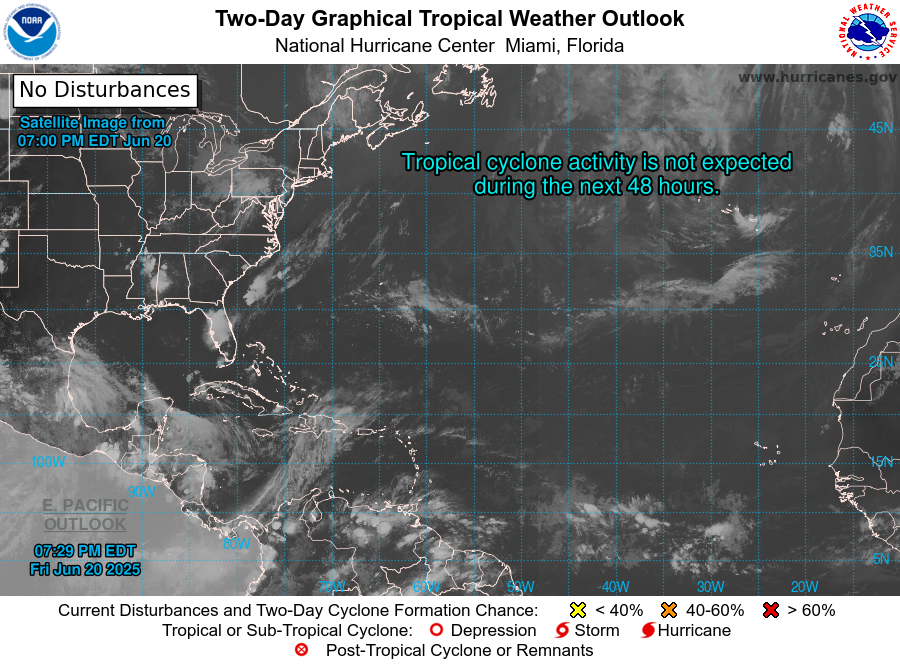
First potential "Cabo Verde" storm 96L


 Last update 4th August: The computer model was right. Looking out the window:  It is going to rain today. I hear thunder already.


Update 3rd August: Chance of formation of a tropical storm is even less now, and the computer model still does not forecast any significant development. However, if you just look at the satellite image below you notice this strong tropical wave about 600 miles to our East (50 degrees West longitude) so expect heavy rain and gusty winds starting Sunday afternoon.


 Update 2nd August: As you see the chances of formation of a tropical storm have been reduced by the hurricane center, the computer models still don't forecast any development. Regardless, it could pass the island chain as a strong tropical wave, bringing rain and gusty winds.


Happy Emancipation day!


The first disturbance for the 2019 hurricane season has been designated 96L by the National hurricane center. They give it a 70% chance to develop into a depression or storm in the next 5 days.
However, there is quite a discrepancy between their forecast and the normally very reliable 7 day GFS computer model forecast.
The GFS had it developing yesterday, but dissipating today by the time it would be approaching the island chain.
I have never seen such a difference in official guidance and the computer model.
So I think it would be reasonable to assume at least a depression could develop next week which will pass through the island chain North of Bequia.
We will keep you updated. (Image above updates automatically)

Wednesday, July 17, 2019

Medical cannabis licenses approved and issued


Press release:

The first licenses to cultivate medical marijuana in St. Vincent have been issued to:

-Eight local farmers' producer cooperatives with an aggregated membership of over 100 traditional cultivators:
Nyahbinghy Order of Rastafari
RastafariFarms
Cannabis Revival Committee (CRC)
SVG RastafariAgri
Grieggs Rastafari progressive society
FancyCooperative
Herbs R Us
South Rivers Producers' Cooperative

-Thirteen traditional cultivators of cannabis who applied individually;

-Three non-traditional local farmers, consisting of one Class A (valuing EC$500) and two Class B (valuing EC$2,500 each);

-Ten companies with the directorship of nationals from the OECS, CARICOM, North America, Europe and Africa. These got the following licenses:
  • One Class A (valuing $100,000) which allows for cultivation of up to one acre of land and is valid for one year.
  • One Class B (valuing EC$250,000 each) valid for 2 years
  • Three Class C (valuing EC$500,000 each) which allows for cultivation of up to 25 acres of land and is valid for three years.
  • Two Class D (valuing EC$1 million each), which allows for cultivation of up to 100 acres of land and is valid for four years.
  • Three Class E licenses (valuing EC$2.67 million each), which allows for cultivation of up to 300 acres of land and is valid for five years.
These license holders have to pay upfront, in the first year, an EC$250,000 food security authorization fee “so that we can use that money to help to strengthen our food security, because we could grow ganja [marijuana] but we can’t eat ganja,” Gonsalves said.

In addition to supplying the local demand, these companies have identified markets in CARICOM, North America and Europe for export of high-quality medicinal cannabis products that meet international standards.


Based on the applications currently under review, it is projected that by September 1, 2019, an additional 200 traditional cultivators will obtain cultivation licenses.
The Medicinal Cannabis Authority (MCA) acting on the advice of the Cabinet, will subsequently announce the date for the operationalization of the Cannabis Cultivation (Amnesty) Act. Sensitization meetings will recommence July 24, 2019, to update the general public of activities taking place within the medicinal cannabis industry.